Our Technology
From collected wood waste to circular panel
A patent-pending, bio-based manufacturing route that replaces formaldehyde-resin chemistry with a mycelium-activated binder system — turning the sawdust and offcuts we collect into new panels.
Every tonne burned for heat is material that could have stayed in use
Sawdust is usually treated as a cost to manage — burned for low-value heat, or paid to have it removed. But the material itself is high-quality, consistent and carbon-rich. The problem was never the sawdust; it's that there's been no route to keep it in use.
That's what the Ábhar process provides. We collect the wood waste a workshop generates and convert it into specification-targeted panels — using no added formaldehyde and no synthetic resins. The waste becomes feedstock, and comes back as panels.
A proprietary Ábhar Technology™ manufacturing route
Conventional particleboard uses urea-formaldehyde resin — a known carcinogen that off-gasses throughout the product's life. Our patent-pending process replaces this entirely with a bio-based binding system activated by a controlled hot-press cycle.
Feedstock Preparation
Collected sawdust is dried, screened, and sized to achieve consistent particle distribution — ensuring uniform density and structural performance across the finished panel. The process accepts softwood, hardwood, MDF, and chipboard sawdust — including formaldehyde-bearing shop-floor dust from MDF and particleboard machining. Rather than being a barrier, MDF and chipboard sawdust is a compatible feedstock: the process reduces residual formaldehyde emissions while binding the particles together. At our facility, integrated shredding and grinding let us take in offcuts and short-end timber waste and process them as feedstock alongside sawdust — so we can collect more than just loose dust.
Biological Activation
Mycelium inoculation binds fibres in a controlled growth environment. The mycelium network infiltrates the particle matrix, creating a natural three-dimensional binding structure.
Binder Integration
A green-chemistry crosslinker system is introduced to achieve structural performance thresholds — replacing all synthetic binder inputs with bio-derived equivalents.
Hot-Press Consolidation
A calibrated press cycle deactivates the biology and locks final panel geometry and density. This step is critical to achieving dimensional stability and EN 312-level compressive strength.
Quality & Finishing
Panels are tested against EN 312 parameters and packed for delivery. The smooth surface accepts veneer, lacquer, and CNC machining with conventional woodworking tooling.
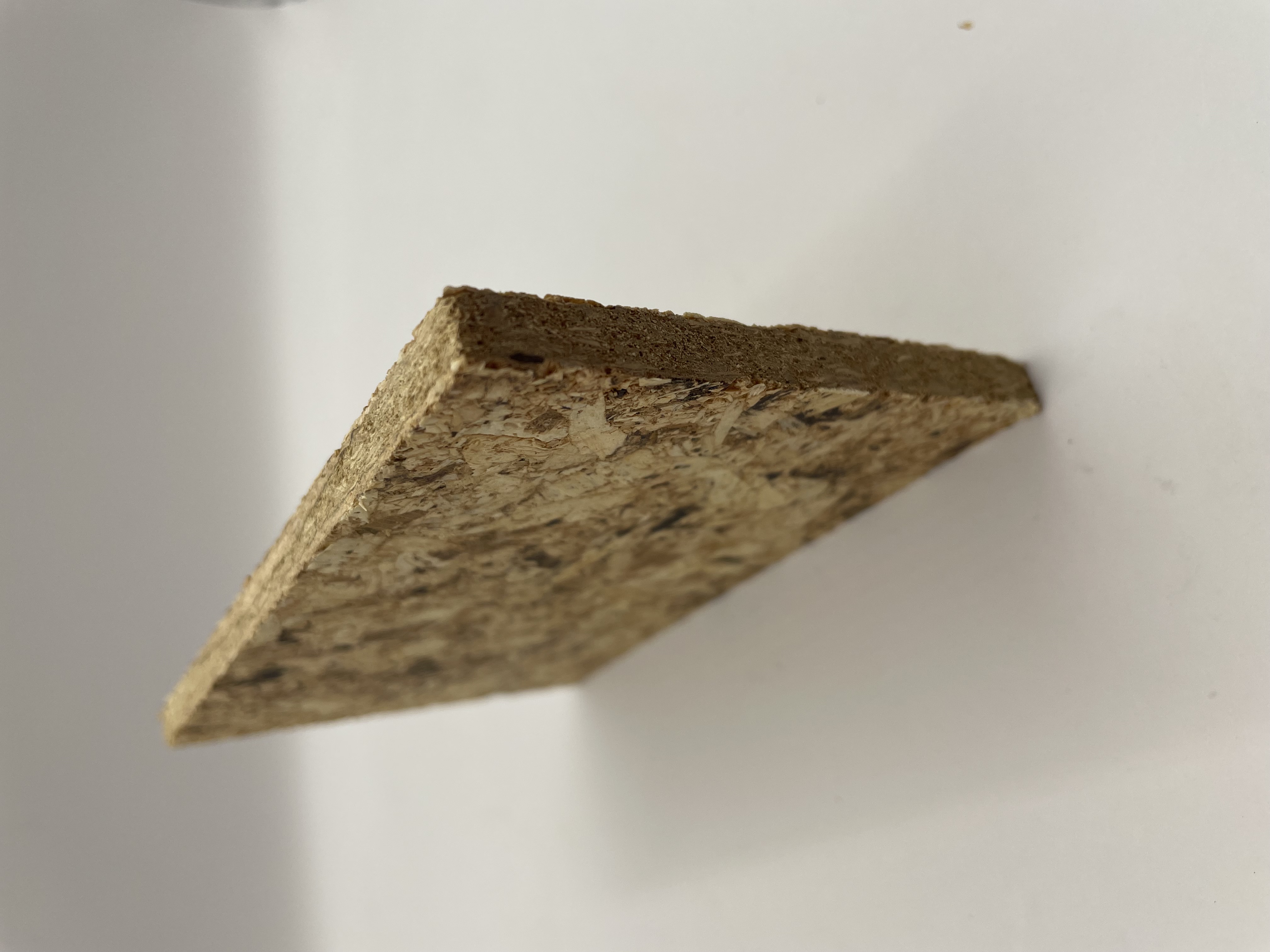
| Parameter | Ábhar Panel |
|---|---|
| Binder type | Bio-based, no added formaldehyde |
| Target standard | EN 312 (structural particleboard) |
| Density range | 150–800 kg/m³ (configurable) |
| Surface finish | Smooth; accepts veneer, lacquer, CNC |
| Feedstock | Softwood / hardwood sawdust, MDF & chipboard shop dust, offcuts (shredded and ground at our facility), agricultural waste (e.g. wheat chaff) |
| Formaldehyde emissions | Ultra low (no synthetic resin) |
| End-of-life | Designed for recovery back into the loop; compostable pathway in development |
| BREEAM / LEED | Specification-compatible |
Want this for your wood waste?
Set up scheduled collection and we'll turn your sawdust and offcuts into circular panels — or see the solid panel first.